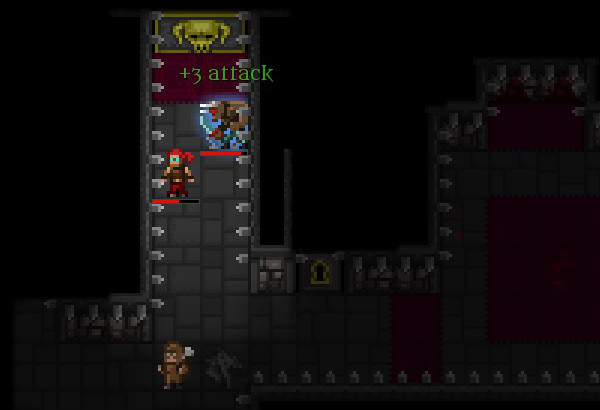
I’ve been way too busy working on CQ2 to keep up with screenshots and trailers lately, so I’m super happy to be able to share this cool preview by Jesse Cox and Josh Mattingly which does a great job of showing off where the game is right now:
Lately I’ve been revisiting tilemap technology.
Way back last February I came up with the approach I’ve been using for most of CQ2′s development: make a handful of little half-size 8×8 tiles, and the system goes and builds everything it needs from those. It was super efficient… but it was kinda inflexible and obscure.
The new system is not efficient.
This is test artwork, stuff that won’t go into the game, but it shows how things work: every single possible tile, up to 47 tiles for a complete set, is laid out separately. Each one is 16x16px but has an 8px bleed area all the way around so it can overlay the tiles around it, like the high walls in the image above.
The system’s really stupid but it gives you total control. Being able to mess with all the tile variants, and having the bleed areas, means it’ll handle all that stuff in last year’s Boundaries post – and more besides – with no code changes, just artwork.
For now, I’ve made the existing forest tiles overlap the tile above.
It’s a start.
It’s amazing how much time in game development can go on everything but game development. I’ve been using the time I’ve had left over the past week or two to sort out loose ends: minor features and persistent, lingering bugs.
The sort of bugs I’m talking about have been in there for months, uncaught, because they’re just so rare and difficult to ferret out. One which came up a lot but which I’d never been able to track down required you to be carrying five consumable items, drop one to picking up a new item, drop that item to pick up a third item and then go try to pick up the first item again.
Another bug required you to charm a Conjuror, wait for the charmed Conjuror to summon an Elemental (which would also be charmed) and then attack the friendly Elemental with a spell. There is almost no reason you’d ever want to do this.
So I’ve been wandering through the codebase, fixing this stuff, while sorting out a few other minor things – like this Paladin class spell, which now has a unique skill type all of its own:
Another loose end tied up is acknowledgement of your chosen difficulty in game with shinier portrait borders:
I think that’s all the little issues out of the way. Over the next two weeks I’ll be working on big changes to Act 1 to get it into as close to a final state as possible. Here goes!
Something’s been bugging me about Cardinal Quest 2 for a while. Yesterday I fixed it.
Gender and skin tone are now customisable.
The concept I’m trying out is that you can have an explicit choice of gender in character creation without the outcome necessarily having an explicit gender. See, it’s a single player game. You know what your character’s gender is – you picked it! If the sprite itself is ambiguous, that’s fine. The characters don’t need to be strongly coded to one gender or the other… I’m thinking they just need to be different, so you can tell you’ve made a choice and the game’s acknowledged that choice.
So I’ve gone for a mix of character designs where some have strong gender signifiers and some don’t, roughly in line with their culture or needs. Practical Fighters slip on bulky, figure obscuring armour; weapon-despising Pugilists, their physiques a defining part of their identities, prefer to travel light; flashy Wizards wouldn’t be caught dead in a muddy field looking like commoners. And so on.
This is perhaps a bit experimental. Choices in games tend to have obvious consequences, so one which has less obvious consequences than it could have might be interpreted as broken rather than making a point. I think I’m OK with that though.
If you’ve got any comments on the character designs re: gender or skin tone let me know. This is something I really want to get right and I’d appreciate pointers.
I’ve been redoing the New Game menu sequence.
This started off as a necessary Chapter Select screen to let you pick between the three chapters of content the game will have. It ended up absorbing a bit more functionality; I needed to rewrite the character selection screen, so I threw it in there. I also realised I’d lost interest in the idea of Bastion-style extra challenges – so I’ve gone for three tiers of carefully calibrated difficulty instead.
It took a while to figure out a new flow that incorporated all these decisions while providing you with the necessary information without feeling overcomplicated, but after fiddling around a ton I’ve finally settled on something. When you hit New Game now, here’s what you see:
There are three acts. Each one is about hunting down and murdering an evil tyrant in the FACE.
The stuff in the bottom corners is the difficulty you’ve cleared that act on with each character. This is important.
Apparently I hadn’t covered this guy before! He’s one of the classical three classes as seen in CQ1 – along with the Fighter and Wizard – who’ve received the CQ2 skill tree treatment.
The Thief is a jerk.
The latest complete class is THE RANGER, who is totally my favourite of the new classes. Though really that’s down to this fella:
See, stuff gets way more tactically interesting when you’ve got a semi-autonomous allied character to control and look after. You have to worry about flanking, line of sight, managing two health bars and so on. It makes the game a bit slower and more involved, but I think that’s okay for one class! It’s a fun change of pace.
I’m a huge believer in visualisation when it comes to system design. I’ll walk through some I’ve been doing over the past week and how it’s helped.
I recently doubled the number of items you can find in CQ2, using some sprites we had lying around (and filling in a few of the gaps). This led to a few issues. I mean, if you want ten items in any given category then you need them all to be unique, right? At the same time, if you use too many different statistics for items in a category, choosing between two items can involve 4 or 5 statistics more often than not. To avoid that I wanted to mostly stick within three core stats for each item category and two for weapons (since they have damage as well).
So it’s a matter of creating as much item diversity as possible with as little diversity as possible. That’s a job for a feature matrix!
I charted this stuff out to help me make sure all the stats get some love and that no two item categories are completely redundant in terms of the trade-offs they ask you to make. The results aren’t totally balanced – I’ve kept some quirks/redundancies just because they work thematically, like most armour providing defence and intelligence/faith/magic resist generally clustering together.
I then drilled down within each category with the same approach. Weapons were the messiest – there are 15 weapons now and that demanded careful attention to ensure they each felt unique.